
Digital Dignity Institute
Back to Work & Family
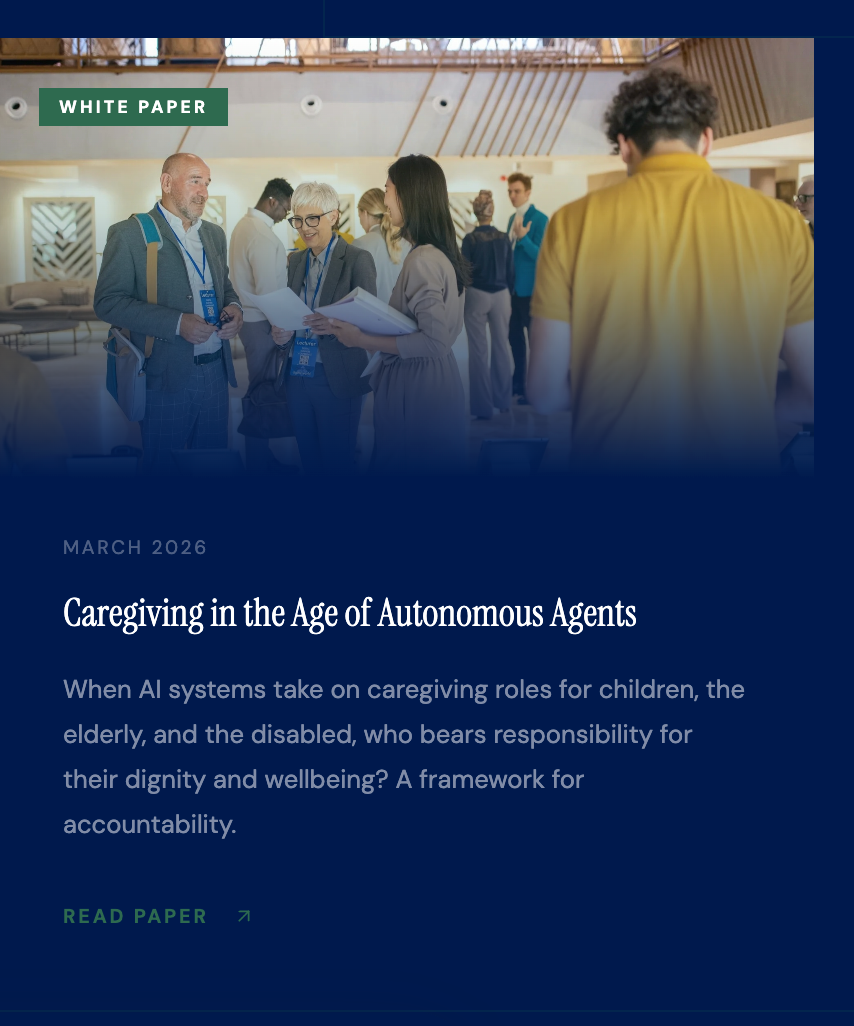
Attendees in conversation at a research conference
White paper

February 2025

Caregiving in the Age of Autonomous Agents

A future-looking framework for the moment AI systems begin to take on caregiving roles for children, older adults, and people with disabilities — and for the responsibilities that must remain human.

Read the paper

A future-looking framework

Preparing before care is delegated

Autonomous care technologies are advancing quickly: systems that can monitor routines, anticipate needs, initiate conversations, coordinate services, and act on a person’s behalf are moving closer to everyday deployment.

This white paper sets out a practical framework for institutions, families, developers, and policymakers to prepare now. It asks how care can be supported by intelligent systems without turning dependence into exposure or responsibility into an afterthought.

Field note

Care happens in real life

A technology can assist with routine and connection, but care remains a relationship. The framework centers the people who give, receive, and remain accountable for it.

Principles

A framework for accountable care

Human responsibility stays visible

Every consequential care decision needs a clearly identified person or institution with the authority and duty to intervene.

Consent must be ongoing

People receiving care and their families should understand what a system can do, what it records, and how its role can be changed or ended.

Autonomy is the outcome

Care technologies should expand a person’s practical choices, not normalize monitoring, isolation, or automated control.

Recommendations

What leaders can do now

  1. 01Set clear limits on autonomous action in homes, care settings, and family services before these systems become routine.
  2. 02Require meaningful human review, accessible recourse, and incident reporting whenever AI participates in a care decision.
  3. 03Design with caregivers and care recipients from the outset, especially people most likely to experience dependency or exclusion.
Explore Work & Family research